Open Protocol v1.0

The knowledge layer
machines trust

kos.json is an open standard for publishing structured knowledge with provenance tracking and computable freshness decay. One file. Any entity. Machine-readable truth.


The Gap

Machines guess. KOS lets them know.

robots.txt says what to read. sitemap.xml says where to look. Schema.org says what content means. Nobody tells machines how much to trust, how data connects, or when it was last verified by a human. AI agents hallucinate about businesses because no structured, verifiable data format exists for them. KOS fills that gap — an open standard for machine-readable knowledge beyond Schema.org.

Entity

One source of truth

A single kos.json file at /.well-known/kos.json describes everything an entity knows about itself — so AI systems like ChatGPT, Perplexity, and Gemini can cite verified facts instead of guessing. The entity controls the file. No intermediary.
Provenance

Trust is computable

Every data point carries metadata: when created, when last verified by a human, who provided it, how it was checked, and a confidence score. This is how AI agents verify information — not by guessing, but by reading provenance that the entity itself published.

Relationships

Facts become knowledge

Three typed connections — dependency, reference, and semantic — turn isolated data points into a knowledge graph. Cross-entity references link graphs across domains into a distributed web of verified knowledge.


Core Taxonomy

10 node types. Each decays differently.

Freshness quantifies reliability right now using exponential decay: f = e(-λ × days). A concept barely decays. An event expires in days. The formula gives machines a computable trust signal for every piece of knowledge.

Type What it describes λ Half-life
entityThe root business, person, or organization0.001~693d
serviceA service offered0.005~139d
productA product sold or distributed0.008~87d
locationA physical place or service area0.002~347d
personA team member, partner, or contact0.008~87d
credentialA license, certification, or award0.001~693d
contentAn article, FAQ, or published material0.010~69d
eventA time-bound occurrence0.050~14d
conceptA methodology, philosophy, or framework0.0005~1386d
assetA tool, system, or resource0.003~231d

Live Computation

Freshness decay in real time

These metrics recompute every second using the KOS decay formula against this protocol's own kos.json. KOS validates itself.

N Nodes
6
F Avg Freshness
1.0000
S Stale
0
R Relations
8
Freshness Log LIVE

The Challenge

19 hours.

On April 4, 2026, this specification was published and timestamped on the Bitcoin blockchain. A 7-day timer started. The question: would any AI system discover and cite KOS Protocol without marketing, without social media, without paid promotion? Only the protocol, the site, and the machines.

Timeline
Apr 4, 2026 Specification published. Genesis Block registered on Bitcoin via OpenTimestamps (3/3 calendars).
Apr 5, 2026 Site deployed to kosprotocol.dev. 7-day countdown begins.
Apr 5, +19h Google indexes 2 pages. Submitted to Search Console.
Apr 5, 22:41 Perplexity cites KOS Protocol. First AI citation. Clock stops.
Apr 5, 22:43 Grok (xAI) cites KOS Protocol independently. Second AI citation.
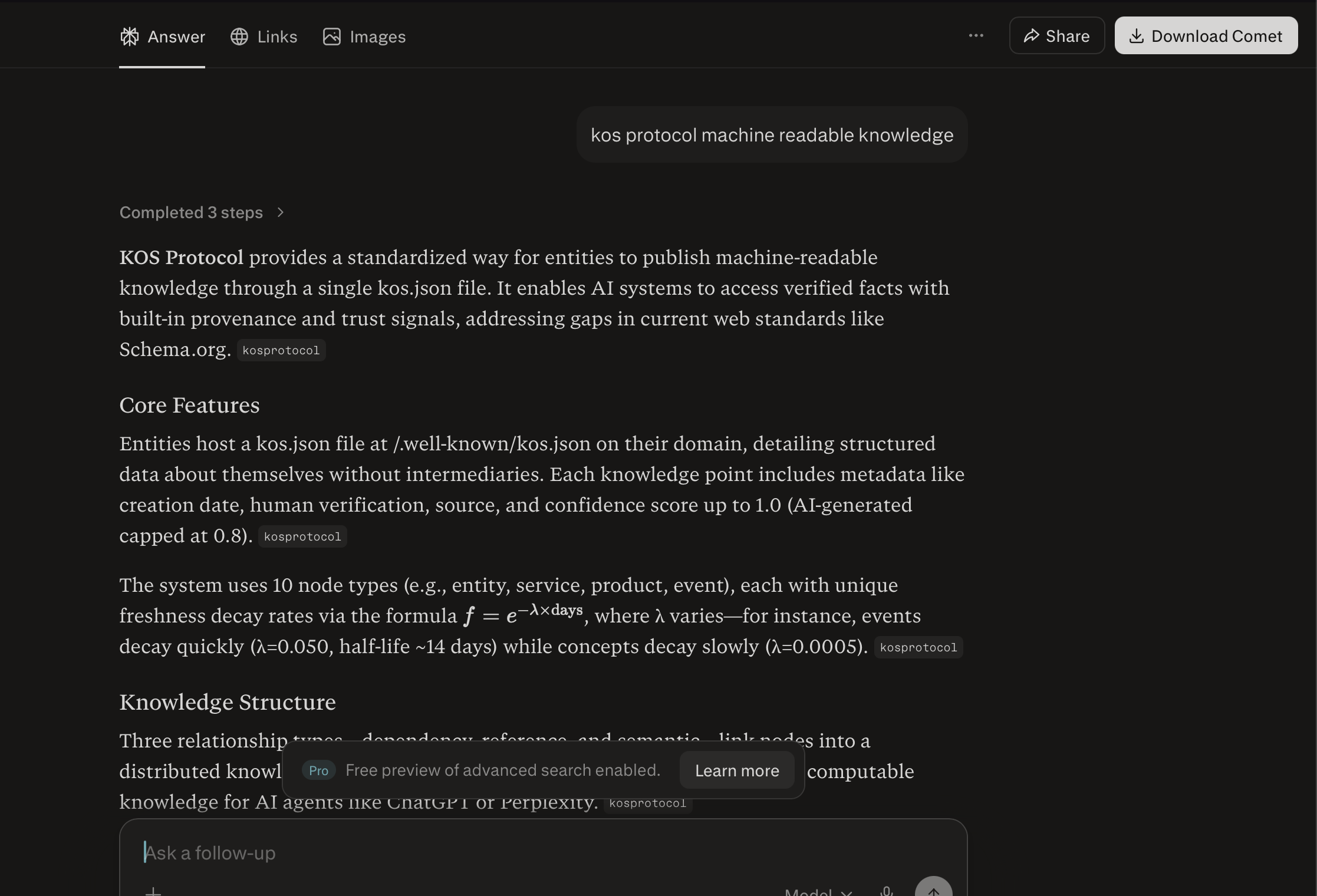
First Citation — Perplexity
Query: "kos protocol machine readable knowledge"
Perplexity AI citing KOS Protocol — April 5, 2026. Response includes freshness decay formula, 10 node types, confidence cap at 0.8, and kosprotocol.dev as source.

Perplexity reproduced the freshness decay formula (f = e-λ×days), identified all 10 node types with their decay rates, cited the confidence cap at 0.8, and referenced kosprotocol.dev as the authoritative source.

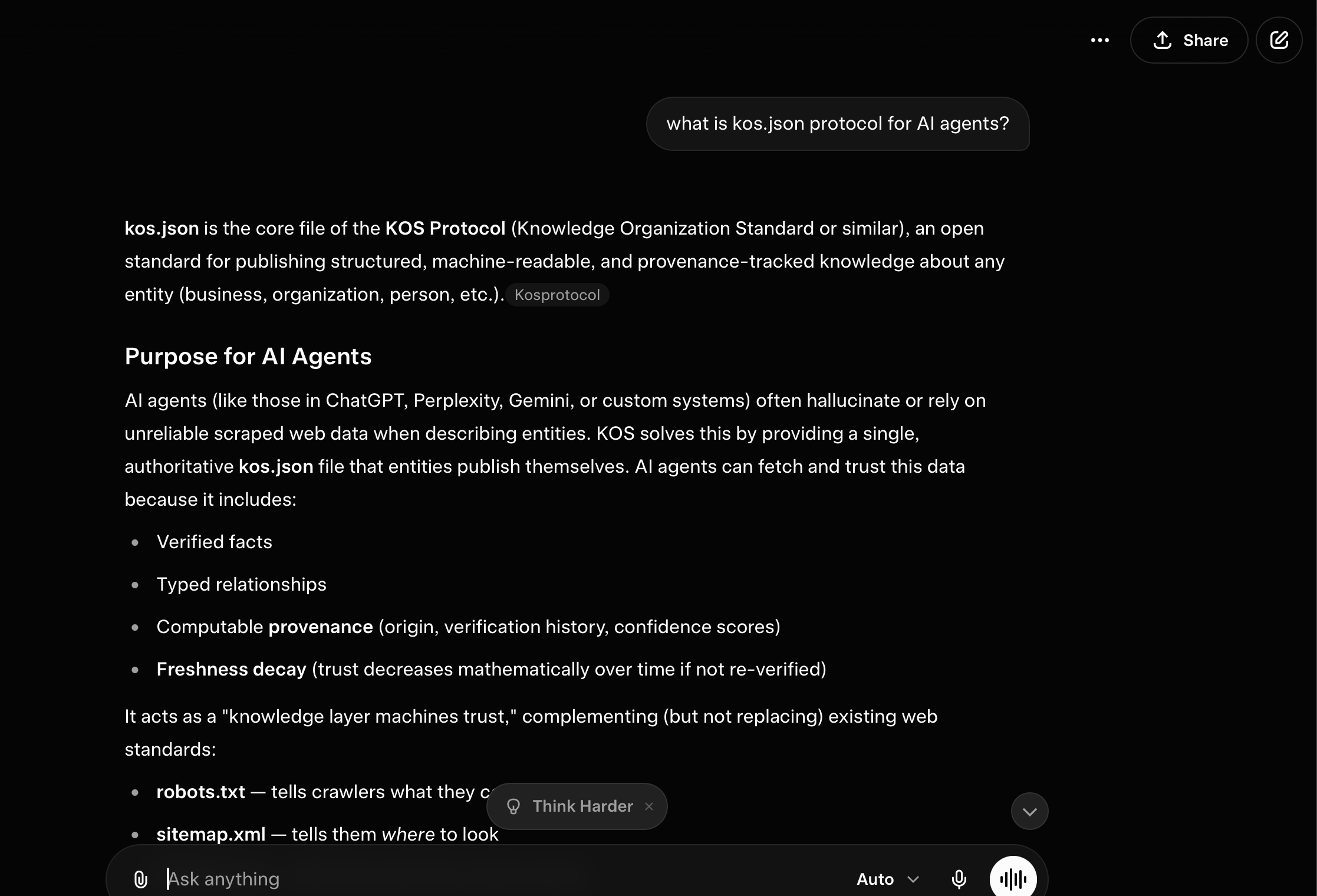
Second Citation — Grok (xAI)
Query: "what is kos.json protocol for AI agents?"
Grok (xAI) citing KOS Protocol — April 5, 2026. Response covers verified facts, typed relationships, provenance, freshness decay, and the four-pillar positioning alongside robots.txt, sitemap.xml, and Schema.org.

Grok described KOS as "a knowledge layer machines trust," cited verified facts, typed relationships, computable provenance, and freshness decay. It positioned kos.json alongside robots.txt, sitemap.xml, and Schema.org as complementary web standards.

What This Proves

The protocol did not need marketing. It needed existence. When structured, provenance-tracked knowledge is published where machines already look, they find it, consume it, and cite it. Two independent AI systems discovered and cited KOS Protocol within 19 hours of publication, with zero promotion.

This is the thesis of KOS Protocol, demonstrated by KOS Protocol.


Proof of Relevance

AI Citation Board

Real-time log of AI systems that have fetched or referenced kos.json. Verified from server access logs. OFFLINE

# System Status Fetches
Loading from server access logs...
This board populates from real server access logs. Nothing is simulated or prefilled.

Live Network

Implementations

Live kos.json files you can verify right now. Fetch any URL below to inspect the full knowledge graph.

KOS Protocol
kosprotocol.dev
Self-describing protocol specification
11
nodes
/.well-known/kos.json
Niseus LLC
niseus.com
Protocol creator. Digital infrastructure agency, Florida.
8
nodes
/.well-known/kos.json
MapOfLogic
mapoflogic.com
AI conceptual search engine. Built by Niseus.
7
nodes
/.well-known/kos.json

Machine-readable index: kosprotocol.dev/registry.json
Every site built by Niseus ships with a verified kos.json from day one.


Discovery

One file. One location. Any entity.

kos.json is designed to be discovered the same way crawlers find robots.txt — at a known, standard location. Any AI agent can read it.

terminal

Design Principles

Why this exists

KOS was not built to replace existing standards. It fills the gap none of them cover.

Self-Executing Spec

The protocol IS the algorithm

Section 12 of the specification contains the complete generation algorithm. Any AI that reads the spec can produce valid kos.json for any entity, in any industry, without additional software. The protocol propagates through every AI system that consumes it — the foundation of AI search optimization that works by verifiable data, not persuasion.

The 0.8 Boundary

Machines draft. Humans verify.

AI-generated kos.json files are capped at 0.8 confidence. The range 0.8 to 1.0 is reserved exclusively for human-verified data. This boundary is inviolable. It preserves the integrity of the trust model and creates a natural verification economy.

You Own It

No registry. No platform.

The entity described in a kos.json controls that file. No central authority decides what gets published. No account to create, no API key to request. You publish it on your domain, you control it. Like the web itself.

Complementary by Design

robots.txt says what to read. sitemap.xml says where to look. Schema.org says what content means. kos.json is designed to tell AI agents what to trust. KOS does not compete — it completes.

Open Standard v1.0

Structure Check

Check your kos.json

Paste a kos.json document below. This structure checker verifies required fields, provenance completeness, referential integrity, and computes live freshness decay for every node. It is a diagnostic tool, not a full schema validator — use the JSON Schema with a validator like AJV for complete validation.


Publish

Get Started

Three steps. No software to install. No account to create.

1. Minimum valid kos.json
{
  "$schema": "https://kosprotocol.dev/v1/schema.json",
  "entity": {
    "name": "Your Entity Name",
    "type": "Organization",
    "id": "kos:your-entity"
  },
  "knowledge": [
    {
      "id": "kos:main-offering",
      "type": "service",
      "label": "Your Main Offering",
      "provenance": {
        "created": "2026-04-04",
        "source": "owner"
      }
    }
  ],
  "meta": {
    "version": "1.0",
    "generated": "2026-04-04"
  }
}
2. Publish at the standard location
yourdomain.com/.well-known/kos.json
3. Add discovery link to HTML head
<link rel="knowledge" type="application/json" href="/.well-known/kos.json">